
Hook And Introduction (1–2 minutes) For as long as humans have dreamed of space, one problem has never gone away: rockets are loud, dangerous, and incredibly expensive. Every launch is like throwing away a skyscraper full of fuel, just to place a few tons of payload in orbit.[1][2] But imagine a future where reaching space is as calm as taking a high‑speed lift in a skyscraper. No fire. No roar. Just a quiet cabin, smooth acceleration, and a window view as Earth slowly falls away beneath your feet.[1][3] This is the story of how humanity built its first **space elevator**, and then a gigantic **spaceline** stretching all the way to the Moon. A pair of machines so ambitious that they turned space travel from a rare event into a daily commute.[4][5] *** ## Chapter 1: The Dream Of A Rope To Space (2 minutes) The idea began as what many people called “impossible sci‑fi.” Scientists imagined an ultra‑strong cable fixed near Earth’s equator, reaching all the way up beyond geostationary orbit—about 35,786 kilometers above Earth—where satellites seem to hang motionless over the same point on the ground.[4][6] At the top of this cable, they proposed a huge counterweight: a station or asteroid that would pull the tether outward, balancing the pull of gravity on the lower part of the cable. Earth’s rotation would keep the whole structure in tension, like a guitar string held tight by two pegs.[4][7] For decades, the materials just weren’t strong enough. Steel would snap under its own weight; even advanced fibers could not handle the stress.[7][8] But slowly, new nano‑materials and composite fibers appeared in labs. They were light, flexible, and stronger than anything humanity had ever made—finally strong enough, on paper, to imagine a real cable to space.[2][8] Engineers stopped asking “Is this fantasy?” and began asking a scarier question: “What happens if we actually build it?” *** ## Chapter 2: Building The First Space Elevator (3 minutes) The construction started far from cities, on a massive floating platform in the equatorial ocean. This location minimized storms, gave clear sky access, and, most importantly, sat directly under the point in the sky where the geostationary station would hover.[4][3] The process began from space, not from the ground. A spacecraft carried a thin “seed cable” out to geostationary orbit, then slowly unrolled it—one end down toward Earth, the other up to the counterweight far above.[6][7] For months, the cable looked delicate and terrifying. Every engineer knew that until it was thickened and reinforced, a single large meteor or debris hit could ruin the entire project.[2][9] Robotic climbers crawled up and down the initial strand, carrying more material and layering it again and again. With each trip, the tether grew thicker, stronger, and safer, just like adding more and more threads to a rope.[3][6] Finally, after years of patient reinforcement, the day came when the elevator could carry its first human passengers. The world watched as the **first orbital climber** docked at the ocean platform, doors sliding open like a futuristic train that somehow went straight up.[1][2] *** ## Chapter 3: The First Ride To Orbit (3 minutes) You are one of the first passengers. You step into the cabin and feel the gentle vibration as the doors close and magnetic clamps grip the cable.[1][2] Instead of a countdown, there is a soft chime. The car begins to rise—slowly at first, then faster, though you feel almost nothing thanks to careful acceleration control.[1][7] Below you, the platform shrinks. The blue ocean turns into a circular patch, then a swirl on a spinning globe. The sky fades from blue to dark purple, and within a few hours, to deep black sprinkled with hard, bright stars.[1][7] Inside the cabin, a display explains what is happening: You are not just going up; you are also gaining sideways speed because the cable rotates with Earth. By the time you reach geostationary height, you are circling the planet once every 24 hours, matching Earth’s rotation perfectly.[4][6] Outside, other climbers crawl along the tether—some going up with satellites and station supplies, others coming down loaded with materials from orbital factories. Compared to rockets, these electric climbers use only a fraction of the energy per kilogram, paid back by years of cheap, repeated trips.[3][2] When you finally dock at the geostationary station, there is no gravity for a moment—just a gentle drift as you push yourself through a hatch into a large rotating ring, where artificial gravity gives you your footing back.[3][2] *** ## Chapter 4: How The Elevator Changes Everything (2–3 minutes) Within a few years, the space elevator transforms human activity in orbit. What used to be the rare launch of a single heavy rocket becomes dozens of climber trips every day.[3][2] Bulk cargo like fuel, water, and construction materials moves up the cable cheaply, allowing the creation of: - Giant space solar power stations beaming energy back to Earth. - Rotating habitats where thousands of people live and work. - Massive telescopes assembled in orbit instead of cramped rocket fairings.[3][9] At the same time, valuable resources from space start coming down the cable. Metal from asteroid mining, lunar oxygen, and rare materials extracted in microgravity are shipped to Earth orbit and then gently lowered to the surface.[9][10] The elevator becomes a **two‑way artery**: Earth feeding space with people and technology, and space feeding Earth with resources and energy. Space is no longer an exotic destination; it has become an extension of Earth’s economy.[3][9] But for visionary scientists, the elevator is only the first step. Because once building vertically becomes routine, a new idea appears: “What if we built a cable that doesn’t just reach space—but all the way to the Moon?” *** ## Chapter 5: The Spaceline – Bridge To The Moon (3 minutes) A group of astrophysicists propose something bold: a **Spaceline**, a cable anchored to the Moon and stretched toward Earth.[5][11] Instead of attaching one end to Earth’s surface, which demands ultra‑extreme materials, this design anchors the cable on the Moon and lets it hang downwards, deep into Earth’s gravity well. The lower tip doesn’t touch Earth but floats tens of thousands of kilometers above it—close enough for spacecraft or even the space elevator to dock.[5][12] Because the Moon’s gravity and orbital motion pull on the cable, and Earth’s gravity tugs on the lower end, the whole structure remains under tension and stable, like a tight string stretched between two moving hands.[5][13] Engineers build the anchor on the Moon, near its equator, and slowly unfurl a long ribbon of advanced material. One end is fixed to the lunar surface; the other reaches toward a point between Earth and Moon, then even closer to Earth.[12][13] At its lowest point, the Spaceline hovers in space, motionless relative to Earth’s center, waiting like a cosmic pier where ships can dock. From there, vehicles can ride up or down the cable to the lunar surface without huge fuel tanks.[5][11] The first test is terrifying. A small robotic climber attaches near the middle of the cable and crawls toward the Moon. The whole world listens for news: Will the tether hold? Will the oscillations stay controlled? Hours later, the message arrives: **Success.** Humanity has just created its first permanent physical link between a planet and its moon.[5][13] *** ## Chapter 6: Life In The Age Of Elevators And Spacelines (2–3 minutes) A decade later, a child born on Earth can describe a trip to the Moon not as a rocket launch, but as a two‑step journey: First, take the space elevator from the equator up to geostationary orbit. Then transfer to a Spaceline car and glide along the cable to the Moon’s surface.[4][5] Students go on educational trips to lunar observatories, where they see the universe with crystal clarity through giant telescopes free from atmospheric blur. Construction crews work on Moon‑based solar farms, beaming clean energy back to Earth with almost no pollution.[12][14] The Moon becomes humanity’s **shipyard**. Using local rock, metal, and ice, engineers build vehicles that never have to waste energy escaping Earth’s deep gravity well.[14][9] From the Moon and the Spaceline hub, missions depart for Mars, the asteroid belt, and beyond. What was once a dead gray world now glows with lights along the terminator line—cities, laboratories, and ports, all fed by the quiet traffic along the Spaceline.[12][13] Back on Earth, launches of massive chemical rockets become rare events. The sky is no longer scarred by constant plumes of fire. Instead, most activity happens along invisible paths: the cable to orbit and the bridge to the Moon.[1][2] *** ## Closing Narration (1–2 minutes) Standing on the observation deck of the lunar anchor station, you look back at Earth. A thin line shimmers in the sunlight, stretching from the blue planet up into the blackness—a human‑made thread connecting two worlds.[12][13] Once, oceans separated continents, and crossing them took courage and months of risk. Then railways and airplanes shrank the Earth, turning distant lands into neighbors.[15][2] Now, space elevators and spacelines have done the same thing to the sky. They have turned low Earth orbit into the new “nearby city,” and the Moon into a reachable destination, not for a few heroic astronauts, but for anyone willing to buy a ticket.[3][5] The narrator ends: “Future historians may say humanity truly left its cradle not on the day of the first rocket launch, but on the day we built a road to the stars… and then, quietly, started using it every single day.” *** This text is already close to a 15‑minute script at normal narration speed (with pauses and visuals). If you want, the next step can be: - breaking this into **scene-by-scene segments** (with timestamps, e.g., 0:00–1:00, 1:00–3:00), and - adding **visual suggestions** for each scene (what AI images or stock clips to
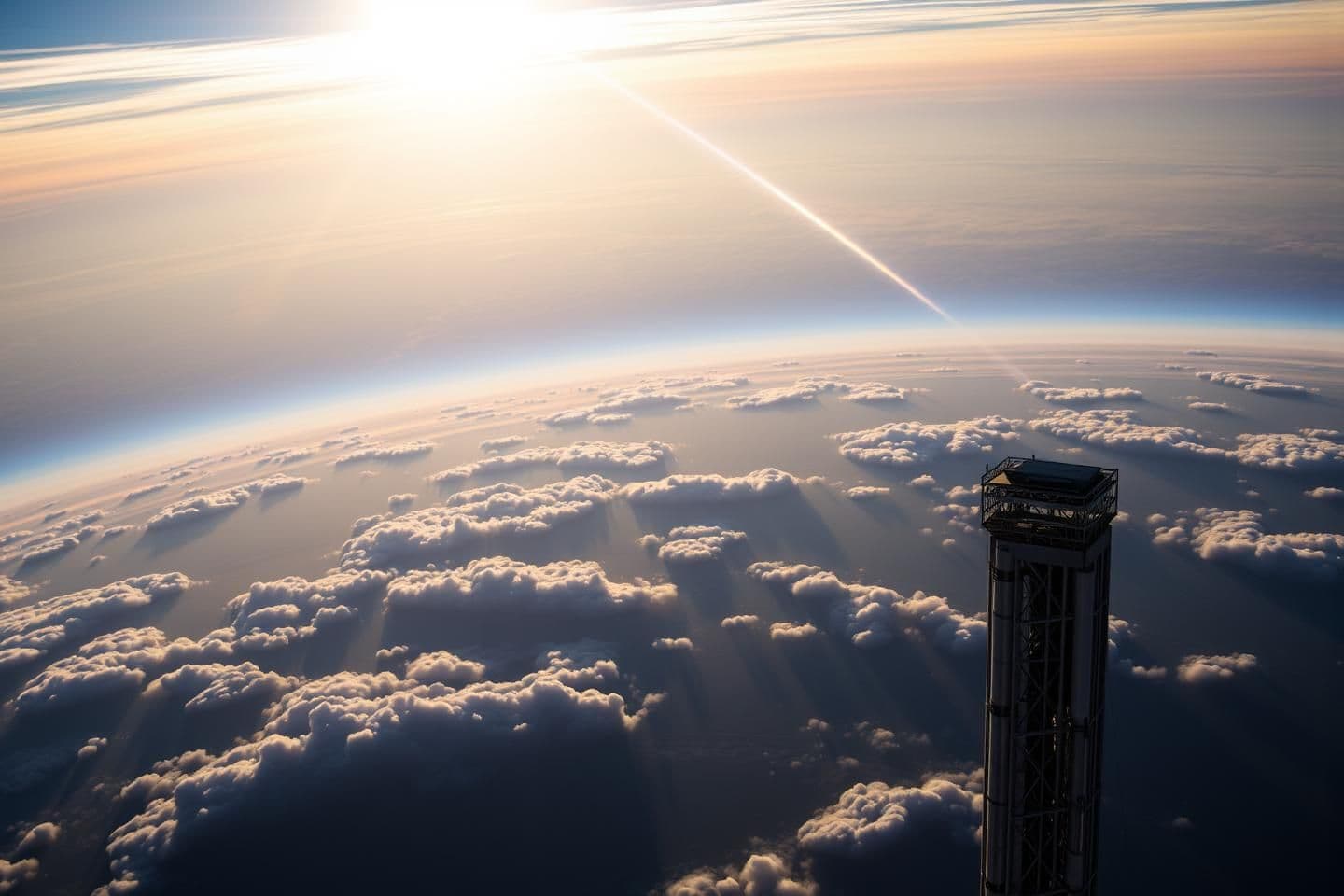
![Hook And Introduction (1–2 minutes)
For as long as humans have dreamed of space, one problem has never gone away: rockets are loud, dangerous, and incredibly expensive.
Every launch is like throwing away a skyscraper full of fuel, just to place a few tons of payload in orbit.[1][2]
But imagine a future where reaching space is as calm as taking a high‑speed lift in a skyscraper.
No fire. No roar. Just a quiet cabin, smooth acceleration, and a window view as Earth slowly falls away beneath your feet.[1][3]
This is the story of how humanity built its first **space elevator**, and then a gigantic **spaceline** stretching all the way to the Moon.
A pair of machines so ambitious that they turned space travel from a rare event into a daily commute.[4][5]
***
## Chapter 1: The Dream Of A Rope To Space (2 minutes)
The idea began as what many people called “impossible sci‑fi.”
Scientists imagined an ultra‑strong cable fixed near Earth’s equator, reaching all the way up beyond geostationary orbit—about 35,786 kilometers above Earth—where satellites seem to hang motionless over the same point on the ground.[4][6]
At the top of this cable, they proposed a huge counterweight: a station or asteroid that would pull the tether outward, balancing the pull of gravity on the lower part of the cable.
Earth’s rotation would keep the whole structure in tension, like a guitar string held tight by two pegs.[4][7]
For decades, the materials just weren’t strong enough.
Steel would snap under its own weight; even advanced fibers could not handle the stress.[7][8]
But slowly, new nano‑materials and composite fibers appeared in labs.
They were light, flexible, and stronger than anything humanity had ever made—finally strong enough, on paper, to imagine a real cable to space.[2][8]
Engineers stopped asking “Is this fantasy?” and began asking a scarier question:
“What happens if we actually build it?”
***
## Chapter 2: Building The First Space Elevator (3 minutes)
The construction started far from cities, on a massive floating platform in the equatorial ocean.
This location minimized storms, gave clear sky access, and, most importantly, sat directly under the point in the sky where the geostationary station would hover.[4][3]
The process began from space, not from the ground.
A spacecraft carried a thin “seed cable” out to geostationary orbit, then slowly unrolled it—one end down toward Earth, the other up to the counterweight far above.[6][7]
For months, the cable looked delicate and terrifying.
Every engineer knew that until it was thickened and reinforced, a single large meteor or debris hit could ruin the entire project.[2][9]
Robotic climbers crawled up and down the initial strand, carrying more material and layering it again and again.
With each trip, the tether grew thicker, stronger, and safer, just like adding more and more threads to a rope.[3][6]
Finally, after years of patient reinforcement, the day came when the elevator could carry its first human passengers.
The world watched as the **first orbital climber** docked at the ocean platform, doors sliding open like a futuristic train that somehow went straight up.[1][2]
***
## Chapter 3: The First Ride To Orbit (3 minutes)
You are one of the first passengers.
You step into the cabin and feel the gentle vibration as the doors close and magnetic clamps grip the cable.[1][2]
Instead of a countdown, there is a soft chime.
The car begins to rise—slowly at first, then faster, though you feel almost nothing thanks to careful acceleration control.[1][7]
Below you, the platform shrinks.
The blue ocean turns into a circular patch, then a swirl on a spinning globe. The sky fades from blue to dark purple, and within a few hours, to deep black sprinkled with hard, bright stars.[1][7]
Inside the cabin, a display explains what is happening:
You are not just going up; you are also gaining sideways speed because the cable rotates with Earth.
By the time you reach geostationary height, you are circling the planet once every 24 hours, matching Earth’s rotation perfectly.[4][6]
Outside, other climbers crawl along the tether—some going up with satellites and station supplies, others coming down loaded with materials from orbital factories.
Compared to rockets, these electric climbers use only a fraction of the energy per kilogram, paid back by years of cheap, repeated trips.[3][2]
When you finally dock at the geostationary station, there is no gravity for a moment—just a gentle drift as you push yourself through a hatch into a large rotating ring, where artificial gravity gives you your footing back.[3][2]
***
## Chapter 4: How The Elevator Changes Everything (2–3 minutes)
Within a few years, the space elevator transforms human activity in orbit.
What used to be the rare launch of a single heavy rocket becomes dozens of climber trips every day.[3][2]
Bulk cargo like fuel, water, and construction materials moves up the cable cheaply, allowing the creation of:
- Giant space solar power stations beaming energy back to Earth.
- Rotating habitats where thousands of people live and work.
- Massive telescopes assembled in orbit instead of cramped rocket fairings.[3][9]
At the same time, valuable resources from space start coming down the cable.
Metal from asteroid mining, lunar oxygen, and rare materials extracted in microgravity are shipped to Earth orbit and then gently lowered to the surface.[9][10]
The elevator becomes a **two‑way artery**: Earth feeding space with people and technology, and space feeding Earth with resources and energy.
Space is no longer an exotic destination; it has become an extension of Earth’s economy.[3][9]
But for visionary scientists, the elevator is only the first step.
Because once building vertically becomes routine, a new idea appears:
“What if we built a cable that doesn’t just reach space—but all the way to the Moon?”
***
## Chapter 5: The Spaceline – Bridge To The Moon (3 minutes)
A group of astrophysicists propose something bold: a **Spaceline**, a cable anchored to the Moon and stretched toward Earth.[5][11]
Instead of attaching one end to Earth’s surface, which demands ultra‑extreme materials, this design anchors the cable on the Moon and lets it hang downwards, deep into Earth’s gravity well.
The lower tip doesn’t touch Earth but floats tens of thousands of kilometers above it—close enough for spacecraft or even the space elevator to dock.[5][12]
Because the Moon’s gravity and orbital motion pull on the cable, and Earth’s gravity tugs on the lower end, the whole structure remains under tension and stable, like a tight string stretched between two moving hands.[5][13]
Engineers build the anchor on the Moon, near its equator, and slowly unfurl a long ribbon of advanced material.
One end is fixed to the lunar surface; the other reaches toward a point between Earth and Moon, then even closer to Earth.[12][13]
At its lowest point, the Spaceline hovers in space, motionless relative to Earth’s center, waiting like a cosmic pier where ships can dock.
From there, vehicles can ride up or down the cable to the lunar surface without huge fuel tanks.[5][11]
The first test is terrifying.
A small robotic climber attaches near the middle of the cable and crawls toward the Moon. The whole world listens for news: Will the tether hold? Will the oscillations stay controlled?
Hours later, the message arrives: **Success.** Humanity has just created its first permanent physical link between a planet and its moon.[5][13]
***
## Chapter 6: Life In The Age Of Elevators And Spacelines (2–3 minutes)
A decade later, a child born on Earth can describe a trip to the Moon not as a rocket launch, but as a two‑step journey:
First, take the space elevator from the equator up to geostationary orbit.
Then transfer to a Spaceline car and glide along the cable to the Moon’s surface.[4][5]
Students go on educational trips to lunar observatories, where they see the universe with crystal clarity through giant telescopes free from atmospheric blur.
Construction crews work on Moon‑based solar farms, beaming clean energy back to Earth with almost no pollution.[12][14]
The Moon becomes humanity’s **shipyard**.
Using local rock, metal, and ice, engineers build vehicles that never have to waste energy escaping Earth’s deep gravity well.[14][9]
From the Moon and the Spaceline hub, missions depart for Mars, the asteroid belt, and beyond.
What was once a dead gray world now glows with lights along the terminator line—cities, laboratories, and ports, all fed by the quiet traffic along the Spaceline.[12][13]
Back on Earth, launches of massive chemical rockets become rare events.
The sky is no longer scarred by constant plumes of fire. Instead, most activity happens along invisible paths: the cable to orbit and the bridge to the Moon.[1][2]
***
## Closing Narration (1–2 minutes)
Standing on the observation deck of the lunar anchor station, you look back at Earth.
A thin line shimmers in the sunlight, stretching from the blue planet up into the blackness—a human‑made thread connecting two worlds.[12][13]
Once, oceans separated continents, and crossing them took courage and months of risk.
Then railways and airplanes shrank the Earth, turning distant lands into neighbors.[15][2]
Now, space elevators and spacelines have done the same thing to the sky.
They have turned low Earth orbit into the new “nearby city,” and the Moon into a reachable destination, not for a few heroic astronauts, but for anyone willing to buy a ticket.[3][5]
The narrator ends:
“Future historians may say humanity truly left its cradle not on the day of the first rocket launch,
but on the day we built a road to the stars…
and then, quietly, started using it every single day.”
***
This text is already close to a 15‑minute script at normal narration speed (with pauses and visuals). If you want, the next step can be:
- breaking this into **scene-by-scene segments** (with timestamps, e.g., 0:00–1:00, 1:00–3:00), and
- adding **visual suggestions** for each scene (what AI images or stock clips to](/_next/image?url=https%3A%2F%2Fluraivin-generated-images.s3.us-east-1.amazonaws.com%2Fimages%2Faf7326f9-cc3b-4f69-8b9e-8a7a603c8e64.jpg&w=3840&q=75)